-1.png?height=120&name=1f83348385b37474578a1d1ffd78b3c8adef03e0%20(1)-1.png)
Last Updated: May 22, 2024
Table of Contents
- Item Quantity Exception Type
- Checking the Bill Item's Quantity
- Investigating a Quantity Issue
- Excluding a Quantity Exception
- Leaving a Quantity Exception
- Disputing a Quantity Exception
Bill exceptions appear on bills as part of the 3-way match process to ensure the bill matches with the order and receipt to make sure you aren't overpaying for items you've ordered. The Item Quantity Exception Type appears when a bill item’s quantity is greater than the linked order item’s quantity. There are several scenarios that can cause a quantity exception, and a different way to address the issue depending on the scenario.
Item Quantity Exception Type
The Item Quantity Exception Type occurs when the bill item's quantity is greater than the order item's quantity.
More than one bill can be linked to the same order, and all of the bills associated with the order can have a bill item on them connected to the same line item on the order. The quantities of the bill items are added together, and, if the quantity total goes over the ordered quantity, the line item that triggers the quantity amount to go over triggers the exception. For example:
- On an order you have item 123456 Blue Gloves with an ordered quantity of 5.
- Bill 1 comes in with bill item 123456 Blue Gloves with a quantity of 3.
- Bill 2 comes in with bill item 123456 Blue Gloves with a quantity of 3.
- Bill 1 will not have a quantity exception because the quantity on the bill item is less than the quantity on the order item.
- Bill 2 will have a quantity exception because the bill item's quantity of 3 is added with the previous bill item's quantity of 3 to get 6, which is over the order item's quantity of 5.
When a bill item is linked to an order item, the quantities are compared to each other. Depending on the variance, the following scenarios will occur:
- If the total quantity on all connected bill items is greater than the order quantity, a quantity exception is thrown.
- If the total quantity on all connected bill items is less than or equal to the order item quantity on, there is no quantity exception.
Some reasons why the bill item's quantity might be different from the order item's quantity are:
- The vendor has a minimum order quantity that they have to follow
- There was a mismatch in unit of measure between the order and vendor's system. For example, you ordered in Each and the vendor always ships in Boxes.
- The vendor sent a free item
- The vendor entered an incorrect quantity amount on the bill
Checking the Bill Item's Quantity
Sometimes, the bill item's quantity can be transcribed incorrectly from the bill. First, check to make sure the bill item's quantity matches the quantity that appears on the attachment. If the quantities match, move on to the next section. If the transcription of the quantity is inaccurate, follow the steps below to update it.
- Click on the Edit Bill button in the upper right corner of the bill tab.
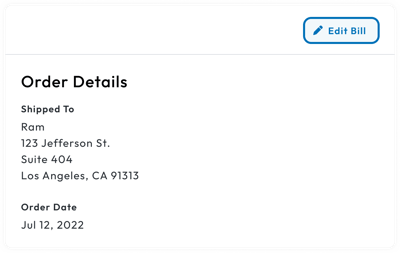
- The Edit Bill modal will open.
- Scroll down on the right side of the bill modal until you reach the Line Items section.
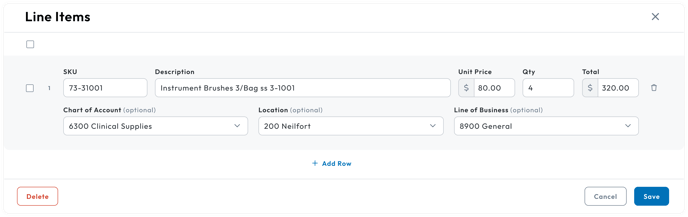
- Find the Line Item with the incorrect quantity
- Update the Line Item with the quantity that appears on the attachment.
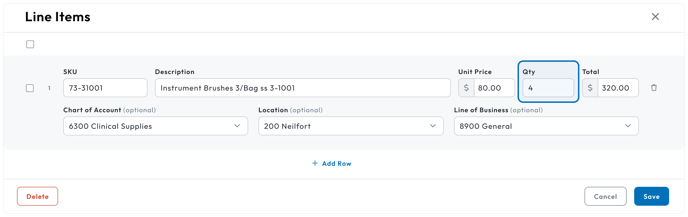
- Click on the Save button in the lower right hand corner.
Scroll down to the line item on the bill to see if the Quantity Exception has been resolved.
- If the Exception badge is gone, the bill item's quantity is now less than or equal to the order item's quantity and no other exceptions exist.
- If the Exception badge is still present, click on the row to view the types of exceptions the item has.
- If a Quantity exception type is still present, follow the steps for investigating a quantity issue.
- If a Unit Price or Total exception type is present, follow the steps in the linked articles to address them.
Investigating a Quantity Issue
It's important to view the quantity variance between the bill item and the order item to ensure you don't overpay the vendor. To investigate the quantity exception:
- Click on the bill line item
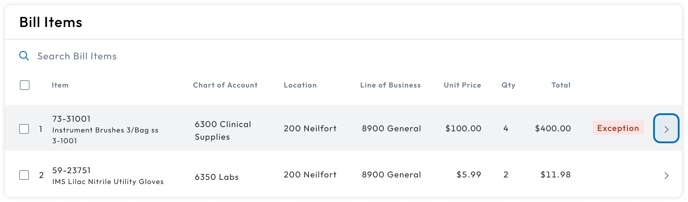
- The Bill Line Item Detail drawer will appear with the order item's quantity highlighted in red
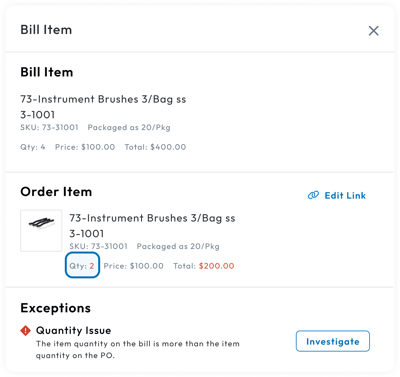
- Under the Exceptions section, click on the Investigate button next to the quantity exception
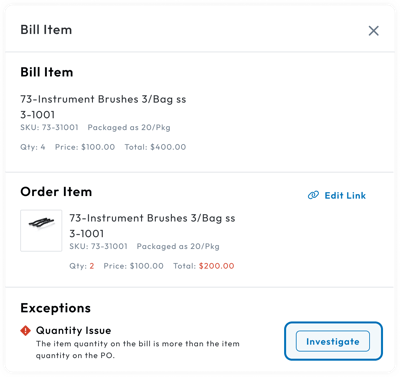
- The Item Duplication Investigation drawer will appear
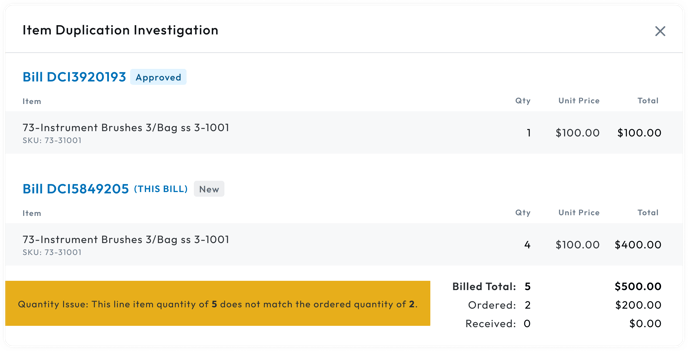
- The drawer will list all bills in order of posted date connected to the order that have a line item connected to the same line item on the current bill that has the quantity issue.
- The different quantities are listed at the bottom
- Calculate the variance between the billed total and ordered total, this is the quantity variance
After viewing the variance in quantities, ask yourself the following questions to determine if the bill item's quantity is incorrect:
- Do I have a bill item with a total of $0 in the list?
- If yes and the quantity is over by that quantity of the $0 item, the vendor likely sent a freebie.
- Are one of the bills a duplicate?
- If yes and the quantity is over by the quantity on the duplicate, voiding the duplicate bill should resolve the problem.
If you determine the item is a freebie, follow the instructions for excluding a quantity exception.
If you determine the quantity on the bill is incorrect or are unsure, then determine how you want to proceed based on the variance of the bill.
- If the variance is small enough that you don't mind paying the bill and don't want to dispute the overcharge later, follow the instructions for excluding a quantity exception.
- If the variance is small enough that you don't mind paying the bill but want to dispute the overcharge later, follow the instructions for leaving a quantity exception.
- If the variance is large enough that you want to withhold payment from the vendor and dispute the bill, follow the instructions for disputing a quantity exception.
Excluding a Quantity Exception
Excluding the item removes it from the 3-way matching algorithm which removes it from having any exceptions. This option should only be used if you are fine with paying the bill and potentially talking to the vendor about the issue later.
Please Note: If there are other exceptions on the bill item, look into those first before excluding the item. Excluding the item will remove all exceptions associated with it.
If there are no other exceptions on the bill, the bill should be moved into the approved bill stage. This option should only be used if:
- The item was a freebie
- You are fine with paying the variance in pricing now and don't need to be reimbursed by the vendor
- Need to get a 2-way or 3-way match on the bill
| Pros | Cons |
|
|
To exclude the item:
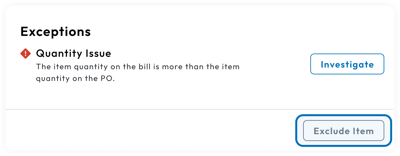
- Click the Exclude Item button in the item detail drawer.
Leaving a Quantity Exception
Leaving the exception keeps the exception tag visible on the bill. This option should only be used if you are fine with paying the bill and potentially talking to the vendor about the issue later. If there are no other exceptions on the bill, it should be moved into the approved bill stage. We recommend leaving a comment on the bill about why an exception is still present if choosing this method. This option should only be used if:
- You are fine with paying the variance in pricing now and bringing it up with the vendor at a later time
- Don't need to get a 2-way or 3-way match on the bill
- Want to keep visibility into the exception
| Pros | Cons |
|
|
Disputing a Quantity Exception
Disputing the item should be done if the variance is above your accepted limit. The bill should be moved to the blocked bill stage while talking with the vendor. We recommend leaving a comment on the bill about why the bill is in the blocked stage if choosing this method.
| Pros | Cons |
|
|
This article is used for documentation feedback only. For more help email help.me@curemint.io